


The Designer Who Sees Systems
Most designers can explain how their product works. But very few can explain why it works that way. The gulf between describing existing UI and understanding how each design decision triggers consequences across an entire organization is enormous.

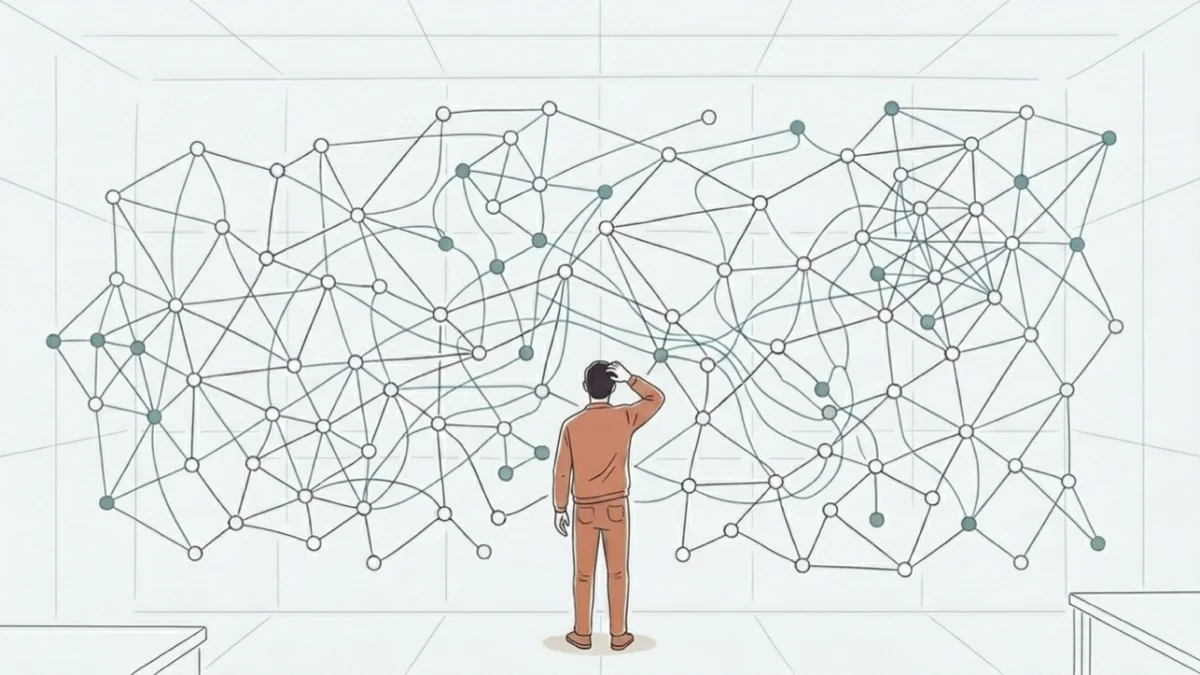
The Map Nobody Draws
If you've spent months building a design system, defining semantic tokens, documenting component variants, and maintaining visual consistency across platforms, it is natural to believe you are engaging in systems thinking.
And to an extent, you are. Designing component libraries requires understanding cascading dependencies and hierarchical relationships. That is undeniably systematic.
Yet it is systems thinking of limited scope, because it operates entirely within the perimeter of the interface.
If we want to practice systems thinking in the truest sense, we must step outside that glass boundary. As an old mentor of mine used to say: "Always hold the full map of the business in your head while tweaking a microscopic detail on the screen."
The Consequences That Never Appear in Figma
There is a foundational book on this: Thinking in Systems by Donella Meadows. It isn't a design book, it is a study of complex systemic structures, which is why it is so profoundly useful for product designers. It teaches you to see relational dynamics instead of isolated objects, and ripple effects instead of discrete actions.
When applied to Product Design, it means a change is never simply a change of screens.
Consider this scenario: You streamline an onboarding funnel by removing a friction-heavy verification step to boost sign-up conversion. Conversion jumps by 12%. The dashboard glows green, leadership celebrates, and congratulations are shared.
Three months later:
- Customer Support is drowning in double the volume of support tickets due to misconfigured accounts.
- Risk and Compliance flag unauthorized users who slipped past the weakened threshold.
- Users who completed the flow churn prematurely because they never actually understood the value proposition they signed up for.
Sound familiar? The designer who only looked at the screen boosted one metric, and inadvertently broke four others across the company.
"A change is never just a change of screens. The designer who only looks at the UI can easily boost one metric while quietly breaking four others."
AI Turns Everything into a System
Thinking in systems has always mattered, but we used to have a built-in safety buffer. When designing a multi-step flow took days of wireframing, user mapping, and stakeholder syncs, you had time to digest what you were touching. The process was slow, and that slowness quietly protected you.
With AI, that buffer has collapsed.
Generating screens, flows, and variations now costs almost nothing. And when the cost of production plummets, the risk of producing without comprehension multiplies exponentially.
That is precisely where you, as a strategic product designer, play your strongest hand if you master systems thinking.
Cultivating Systems Thinking Before You Need It
Systems thinking cannot be acquired through a weekend certification. It is trained by sitting in meetings outside your discipline, reading literature far removed from design, and asking seemingly naive questions until the unspoken assumptions fall apart.
Above all, it is forged in those uncomfortable moments when someone asks a deceptively simple question about how the product functions behind the scenes, and you realize you don't know the answer.
When you wrap up your next design iteration, ask yourself: "Which department outside product and design will feel the reverberations of this decision three months from now?"
If you don't have a clear answer, you have an urgent conversation to schedule. Tools will inevitably keep evolving, but the Product Designer who understands the whole system will always know what they are truly moving.