


The User Will Send an Agent
I've spent weeks designing flows for users who might never actually see them. Not because they are flawed flows, but because the "user" navigating them may no longer be human. That reality is completely rewiring how I think about Product Design.

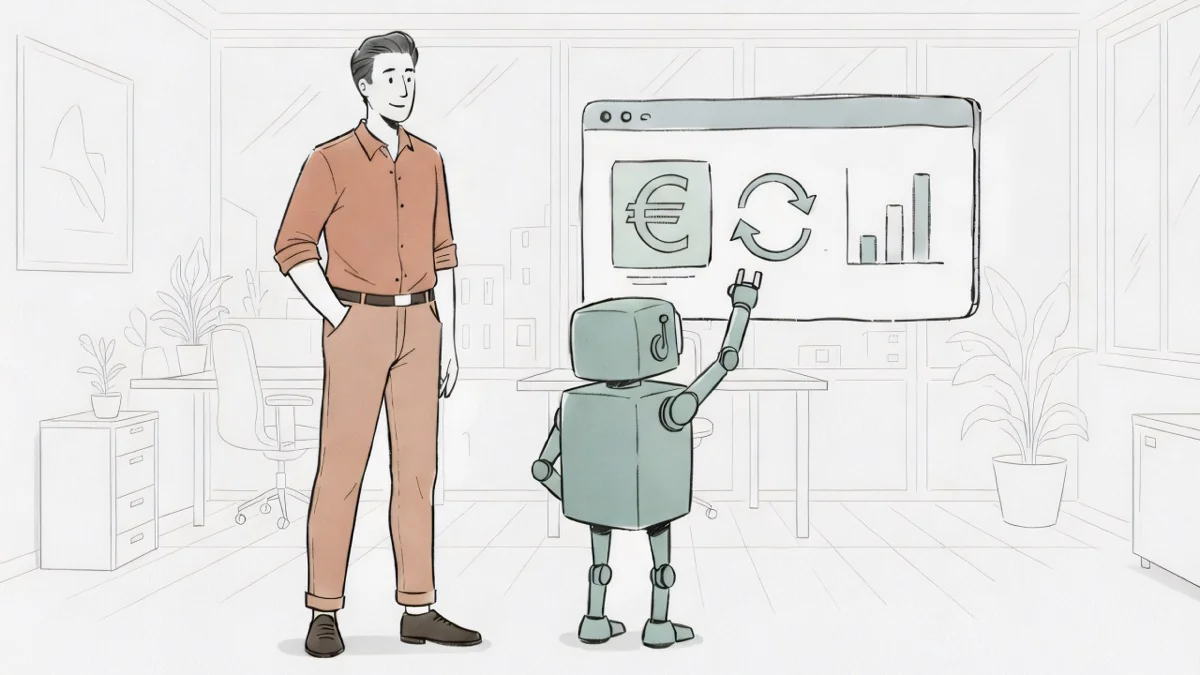
Mastercard recently executed the first autonomous payment performed end-to-end by an AI agent. Visa rolled out a dedicated protocol enabling autonomous agents to transact with payment credentials. BBVA struck a direct alliance with OpenAI. JPMorgan has over 450 AI use cases live in production.
This is not a five-year speculative roadmap. This is happening today.
While the initial headlines emerge from banking, the pattern extends to any digital product where humans perform repetitive, procedural tasks: e-commerce, insurance, healthcare, logistics, telecom. If an operation is mechanical and rules-based, it is a prime candidate for delegation.
The user won't show up themselves. The user will send someone else: an autonomous agent operating on their behalf.
Designing for Someone Who No Longer Looks at the Screen
Consider how people interact with online banking today: unlock the app, locate transfers, enter account details, double-check amounts, confirm. Step-by-step mechanical rituals created for a human looking directly at illuminated pixels.
Now imagine that same person telling their personal agent: "Pay the rent," or "Transfer €500 to savings if I stayed under budget this month." The agent connects, negotiates the protocol, executes the task, and confirms the outcome. The human transitions from manual operator to high-level supervisor.
Which prompts a confronting question: what are we actually designing all of this for?
The intricate branching flows, the micro-animations, the meticulously crafted onboarding tutorials, all tailored for human eyes. What happens when the entity navigating your product is software?
Design Isn't Disappearing. Its Object Is Shifting.
The conclusion that makes the most sense to me is that design is not dying; it is changing what it designs for.
We are witnessing a shift from UX to AX: from User Experience to Agent Experience.
- Fewer wireframes, more operational playbooks.
- Fewer hover states, more rigorous API contract consistency.
- Less emotional micro-copy, more structured, deterministic data schemas.
"Continuing to design exclusively for humans is designing for irrelevance."
The Complete Chain Most Teams Are Missing
The most critical aspect isn't the AI agent in isolation. It is the full tripartite relationship:
Human ⟷ Agent ⟷ Product
The human remains the ultimate anchor of value. But the direct touchpoint with your product has evaporated. That implies two fundamentally different interfaces:
The first interface is the dialogue between the human and their agent: how they delegate, how permissions are established, and how confirmations are requested. That layer is being built by the likes of OpenAI, Google, Anthropic, and Apple.
The second interface belongs to us: the handshake between the agent and your service. There is no screen in between, only APIs, machine-readable semantics, and protocols that either work flawlessly or fail silently.
Here lies the fatal trap: if you fail to comprehend how humans delegate intent, your technical layer will be fundamentally flawed. And if your product cannot be operated effortlessly by an agent, you will quietly cease to exist for an ever-growing share of your customer base.
The Present Hurdle: Trust and Regulation
In a recent YouGov survey, only 19% of US consumers reported trusting AI to manage their finances. One in five. Skepticism is global and well-founded.
Furthermore, in Europe, regulation lags behind technological capability. Strong Customer Authentication (SCA) mandates that a human must explicitly authorize sensitive transactions. Legally, AI agents cannot yet act completely unattended.
We find ourselves in a liminal transition: technology is ready, regulations are catching up, and societal trust is still fragile. Over the coming years, our products will receive simultaneous visits from humans and autonomous agents. Designing exclusively for one of them is a strategic mistake you can easily make today.
I don't claim to have every answer, but I do hold one conviction: for product designers, this demands thinking less about individual screens and more about whole systems. Less about what a user sees, and more about what an agent understands. Less about screen-to-screen UI flows, and more about robust information architecture.
Product design is fundamentally shifting. The designers who start grappling with these questions today will be the ones defining how digital products are built tomorrow.
Because sooner than you think, the user will send someone else.